
Practical tasks
From client request to working brief: questions, first version, feedback and approval.
“We need a beautiful website” is not yet a task. In this practice, you will go from a vague request to a document that helps the client and designer understand each other.
One project, four stages
You will analyze the request, prepare an interview, draw up a brief and finalize it after feedback. The important thing here is to state the task before design: creating a logo, website or layout is not required. IN chapter 6 you went through the entire design process; Now let's look at its beginning in detail.
Workshop "Binding"
Start with the client request on this page. All client answers are prepared by the course; no real customer needed. The case is completely fictitious.
Real challenge
Go through the same steps with your submissions and feedback. Before submitting, hide sensitive information, names and contacts. Save the basis for your conclusions.
Both ways are equivalent. Work in any text editor. Keep two separate versions of the brief: v1 before feedback and v2 after feedback.
Brief template
Blank editable document with tips for both versions. This is the structure for your work.
Parse the original request
The goal is to see the problem behind the proposed solution. Read the message and note what you already know and what you are just guessing.
Letter from the Binding workshop
Hello! We are a small workshop called Binding: we work with books and family albums. We want to update the design so that more people know about us. We probably need a new logo and a beautiful website - now everything looks old-fashioned. We like it to be modern, warm and without too much seriousness. I would like the workshop to suit everyone: young people, families, and older people.
Recently we were offered to show the workshop at a regional event. I would like to have time to prepare and at the same time tell about myself on the Internet. We have photos, an old sign and some reviews, but everything is stored in different places. You can take something from this. First of all, it is important for us that people understand what we do and start contacting us. We have not yet decided how best to show this.
The time frame is quite short, the budget is small. Tell us what you can offer and how much it will cost. It is advisable to first see a couple of beautiful options - then it will be easier to choose a direction.
- Divide the request into four groups: information provided; client estimates and assumptions; unknown; prematurely proposed solutions.
- Please indicate the source for information. “Everything looks old-fashioned” is a customer assessment, not a proven cause of the problem.
- Formulate a work problem and label it as a hypothesis before the interview. Write down what information is missing to check it.
Example of query parsingDo your own parsing first
- “There is an old sign and photographs.”
- Reported materials information. You need to see the files and clarify the terms of use.
- “The workshop should suit everyone”
- Client's wish. The audience and communication situations have not yet been determined.
- “We probably need a new logo and website.”
- Proposed solution. Its connection with the problem has not yet been substantiated.
- “Short deadlines, small budget”
- Unknown restrictions. We need a deadline, scope of work and budget limit.
Working hypothesis: People may not understand what the workshop does. It needs to be tested with questions about the client’s current requests and observations.
Stage result: an annotated request, a list of information gaps and a working problem.
Prepare an interview
The goal is to obtain answers that determine the task and composition of the project. Start with open-ended questions: they allow the person to explain the situation in their own words.
- Write questions about the company, the problem, the audience, the message, the materials, the results, the limitations, and the alignment.
- Divide them by priority: what you can’t start without and what you can clarify later. Next to it, briefly indicate which decision depends on the answer.
- Save the questionnaire. Then open R1 and note which gaps are resolved and which are left.
Example of priority questionsEleven questions to compare with your list — not a required total
Before the project starts
- What services do you provide and what tasks do people come to you with?
- What doesn’t work in your current communication with people? What calls or observations show this?
- For whom is it most important to solve the problem now and in what situation will these people encounter the message?
- What should a person understand and what action can he perform after reading the materials?
- What materials are needed for the event and the Internet? What will be included in this project, and what can be postponed?
- What sign, texts and images already exist? Who will transfer the files and confirm the right to use them?
- What site requirements, printing requirements and content restrictions need to be taken into account?
- By what point are results needed, what does the start of work depend on and what budget is available?
- Who makes the decision, who collects comments, and how are approvals and changes recorded?
- By what observable signs will you accept the result? What still requires separate verification?
Can check later
What visual examples are close to you and what exactly fits the task in them?
For example, the answer about media determines the amount of work. Therefore, it must be obtained before estimating the time and cost. After an open question, precise clarifications are appropriate: number of media, size, file format.
Stage result: a questionnaire with priorities and an explanation of why the answers are needed.
R1 · Simulated client responsesQuestionnaire is ready - open answersUse this information for the first version of the brief
These are the conditions of a fictional case. If your question is not answered here, add it to the list of clarifications.
1. Company and reason for contacting
We repair personal books and family albums: we strengthen bindings, return fallen pages, and replace covers. We do not sell new books. From our observation, people sometimes mistake us for a bookstore. We have not collected enquiry records or conducted research to confirm this.
2. Audience and situation
For this project, we will select owners of books and albums who want to preserve a specific item. They will meet us at a local event or see a publication about it. This is a working choice of the client based on workshop experience, without separate research.
3. Message and Action
It is important to explain that we repair books and albums. We offer to send photographs of the item for preliminary evaluation. We cannot promise an exact price and full restoration prior to inspection. The form address for sending photos has not yet been selected.
4. Composition of results
We need one vertical A3 poster for the event and one digital card 1080 × 1350 px. One consistent version of each media. The website and new logo are not included in this project.
5. Materials and formats
We will keep the existing sign. The owner will give the sign and selected photos to the workshop; you need to check files and permissions. Digital result - PNG in sRGB; printed - PDF according to the requirements of the printing house, which do not yet exist; additionally editable source and list of fonts used.
6. Time frame and budget
The desired period is 21 calendar days after the brief has been agreed upon and all materials have been received. The maximum design budget is £600; printing is paid separately. Whether the contractor will meet the deadline and budget still needs to be confirmed. These numbers are the terms of the case study.
7. Coordination
The owner makes a decision, the administrator collects one list of comments. Feedback - in writing by email. We record changes along with their impact on the time and cost before the work is completed. The statement refers to a specific version of the document.
8. Acceptance
We'll make sure both media explain the service, have a consistent method for submitting photos, use approved materials, and are consistent in formats. It is impossible to promise an increase in requests without initial measurements. The exact contact details and requirements of the printing house still need to be obtained.
Compile the first version of the brief
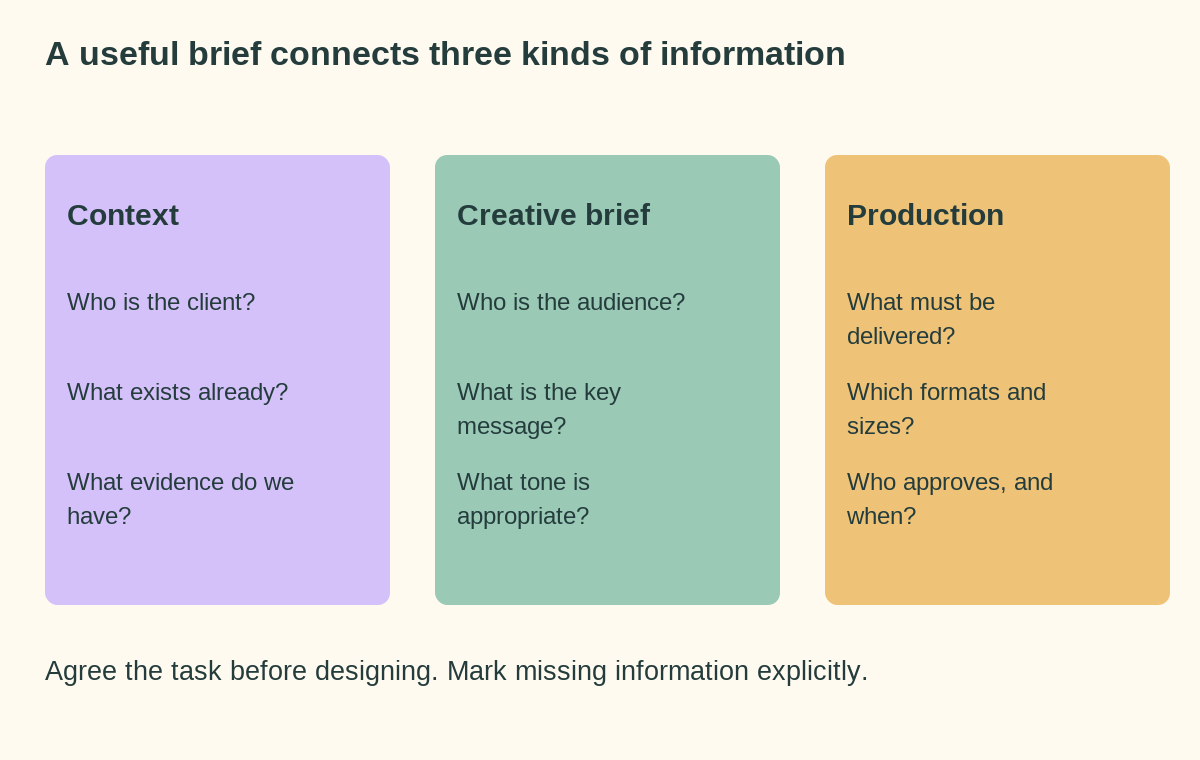
The goal is to turn the answers into a coherent working document. The brief explains why the project is needed. Its technical part records media and formats. The creative direction - a visual way to solve a problem - will appear later, at the design stage.
- Company and product context.
- The problem and the goal of the project, separated from each other.
- Audience, situation of use and the basis for this choice.
- One priority message and expected human action.
- Results, media, number of options and formats. Separately - what is not included in the project.
- Materials, restrictions and those responsible for their clarification.
- Deadline, budget and conditions for starting work.
- The procedure for feedback, approval and recording of changes.
- Observable acceptance criteria associated with the task.
Fragments of training brief v1An example of a record with which you can check your version
Context and problem
Binder repairs books and albums. The client reports that the workshop is sometimes mistaken for a store; There is no documented record of enquiries [R1, paragraph 1]. Working hypothesis: the service is not clearly named in the communication. We do not claim that the reason is the logo [the author's conclusion based on R0 and R1].
Purpose and message
Prepare event materials that clearly explain the repair service and show how to submit photos of the item for a preliminary assessment. Main message: the workshop repairs personal books and albums; repair conditions are clarified after the assessment [R1, clause 3]. An increase in requests is not set as a guaranteed result.
Audience and composition
Owners of books and family albums who want to preserve a specific item; the basis is the client’s experience, without research [R1, paragraph 2]. One vertical A3 poster and one card 1080 × 1350 px. The existing sign is retained; redesign and website are not included [R1, paragraphs 4–5].
Organization
Desired client conditions: 21 calendar days from approval and receipt of materials, up to £600 for a design without printing. The contractor must still confirm feasibility. Owner approves; the administrator transmits summary written comments [R1, paragraphs 6–7].
Open questions
- Owner: form address and current contacts - until final verification of texts; sign and photos with permissions - before design begins.
- Responsible for printing: requirements of the printing house - before preparing the printed file. Who plays this role still needs to be clarified with the owner.
- Contractor: confirmation of deadline and budget - before the start of the project.
How to clarify vague wordingThree examples from the same case
“It needs to be modern and for everyone”
- Question
- Who is the message addressed to and what should the person understand?
- Record in the brief
- Owners of books and albums who want to preserve a specific item. We inform you about the repair service and suggest sending a photo [R1, paragraphs 2–3].
"The deadlines are short"
- Question
- At what point is the result needed and what does the start of work depend on?
- Record in the brief
- The client wants to receive materials 21 calendar days after the brief has been agreed upon and the materials have been transferred. The Contractor must confirm the deadline [R1, clause 6].
“Show beautiful options first”
- Question
- What will be included in the project and by what criteria will you accept the result?
- Record in the brief
- One agreed upon version of the A3 poster and digital card. We check the clarity of the service, the method of sending photos, materials and formats [R1, paragraph 4, 8]. The number of search options has not yet been determined.
Stage result: Brief v1 with sources and unresolved issues. Save a separate copy before opening the R2 review.
Check and modify
The goal is to incorporate feedback and maintain a clear decision history. In a real project, get feedback from the customer or editor. In training - open the R2 card after saving v1.
R2 · Simulated client feedbackVersion v1 saved - open reviewTwo clarifications for the next version
All other information from R1 remains valid.
1. Digital card format
The event organizer clarified the format of the online publication: a square card is needed 1080 × 1080 px instead of vertical 1080 × 1350 px. No additional card is needed; The A3 poster remains.
2. Who approves the result
For the duration of the project, the final decision will be made by administrator on behalf of the workshop. The owner gave him this role in writing. He collects comments and confirms in writing the accepted version. In the training scenario, role transfer is specified by this response; In a real project, save the proof of authority.
Please update the document and submit it again. This response confirms the clarifications, but is not an approval of the entire brief. We are still clarifying the address of the form, materials and requirements of the printing house.
- Check which sections are affected by each clarification: results, formats, responsibilities, acceptance, deadline and budget.
- Create v2, keeping v1. In the change log, write down the previous requirement, the revised requirement and the response that prompted the change.
- Update associated requirements and acceptance criteria. If the impact on cost or time is not confirmed, note this.
- Prepare a message for agreement: what has changed, what questions are open, and what confirmation is required.
Example of changes in v2Open after your own modifications
Card format
Was: 1080 × 1350 px.
Became: 1080 × 1080 px, instead of the previous card. Reason - R2, point 1. Updated results section and sizing criterion. The A3 poster remains unchanged.
Statement
Was: the owner approves, the administrator collects comments.
Became: the administrator collects comments and approves a specific version. Reason - R2, paragraph 2. Responsible persons and acceptance procedure have been updated.
Consequences and status
The deadline and budget remain the wishes of the client; the contractor must confirm feasibility given the new format. There are open questions about contacts, materials and requirements of the printing house.
Status: ready for approval, with open questions. The scenario does not provide approval of the complete document.
Message for approval
“I am sending brief v2: I replaced the card format and updated the person responsible for approval based on your feedback. Specify the address of the form, the composition of materials and the requirements of the printing house. After receiving the data and confirming the deadline and budget by the contractor, I will send the full version for approval.”
Stage result: v2, change log and short message for approval.
Show the entire solution path
Collect one PDF. At the beginning, indicate the type of case: “training” or “real”. The number of pages is not fixed: completeness and readability are important. An editable brief file can be attached additionally.
- The original request, its parsing and the list of information gaps.
- Priority issues and explanation of priorities.
- Client responses and source designations.
- The first version of the brief is v1.
- Received feedback or R2 card.
- Brief v2, change log and message for approval.
Before submitting, open the PDF and make sure that the text is readable, both versions are distinguishable, the pages are in place, and non-public information has been removed. One final brief is not enough to validate interviews and revisions.
What is important in your work
We check the quality of the problem statement. Graphic design of the PDF does not provide a separate point. Below is a trial author’s course scale: four criteria of 5 points each, maximum 20. Before the scale is approved, the points serve as a feedback guide.
Analysis of the request
A distinction is made between reported information, assumptions, unknowns, and solutions. The problem is formulated without changing the medium; hypotheses are marked.
Quality of questions
Questions close important gaps, allow for meaningful answers, and have an explainable priority.
Completeness and clarity of the brief
The purpose, audience, message, results, constraints and work flow are agreed upon. Sources and open questions are visible.
Review and revision
v1, review, v2 and justifications for changes have been saved. Consequences taken into account; the approval status corresponds to the confirmation received.
How to read the rating scaleGeneral levels for each criterion
- 0: required material is not included in the confirmed complete set.
- 1–2: The work has been partially completed; significant gaps remain.
- 3–4: The problem is solved, there are some minor inaccuracies.
- 5: the solution is clear, justified and suitable for the next stage.
The choice within the range is explained by the size of the gaps and whether they interfere with further work.
If the file is unreadable, truncated, or the set may be incomplete, the missing data is needed first. This is not an automatic zero. If the criterion is not verified, record “insufficient evidence” and the overall score is not calculated.
Feedback ExamplesStrengths, specific gaps and next step
When there are many gaps in work
“You indicated the media, but the goal so far sounds like “to make it modern.” Show the problem with reference to R1; Instead of “for everyone,” write down the selected audience. Then add the owner and deadline for clarifying the address of the form. This will provide insight into what future design should address.”
When the main problem is solved
“You maintained the distinction between the client's message and your hypothesis, linked the goal to the person's action, and addressed both R2s. It remains to indicate who confirms the impact of changes on the deadline and budget. After this, you can send v2 for approval.”
The case, mock client responses, and examples are designed for practice in Chapter 8. These are course materials.