
 Practice for Chapter 3
Homework
Gestalt in practice: express ideas in simple forms, improve compositions and break down finished designs.
First you will create six compositions from identical squares, then rework them after feedback. In the last task, you will find Gestalt principles in the finished design and suggest an improvement. This is how the theory of perception turns into a working tool.
How to complete tasks
For the first two tasks, prepare white and black paper, scissors, glue and squared sketch paper. For revision, black squares of different sizes, white chalk or a marker with paint will be useful. You can work in a digital editor, maintaining the specified dimensions, proportions and restrictions.
Start with quick variations, choose one solution for each word, and save all original compositions. After feedback, make revised versions. In the third task, use your own examples of a poster, cover, packaging or website.
For each work, add a short explanation: what Gestalt principle you applied, what the viewer should see, and why you changed the original version.
Task 1. Black squares
Convey a complex idea without words—only through the arrangement of simple shapes. Create six compositions: “order”, “growth”, “boldness”, “overwhelm”, “tension” and “playfulness”.
For each composition, use four identical black squares on a white square sheet. Vary distances, direction, and placement so that meaning emerges from the relationships between shapes.
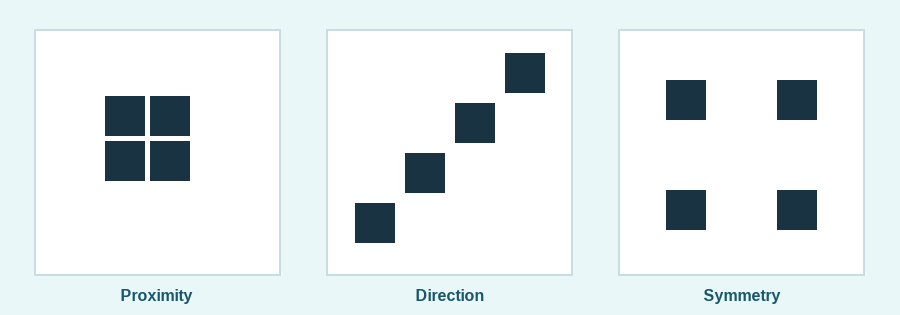
Stages of work
- For each of the six words, explore several options in quick sketches on squared paper. There is no required number of sketches here.
- Compare the options: how do proximity, similarity, symmetry, figure and ground, continuation or closure work? What solutions help convey the chosen word?
- Choose a solution for each word, place four squares on a white sheet and only after choosing, glue them.
- For each composition, write two or three sentences: what principles are at work, why you chose this arrangement, and how you used balance, rhythm, or other compositional properties.
Task 2. Discussion and revision
Go back to the six compositions from assignment 1. Get feedback from a AI tool, teacher, or other person. Compare which words read convincingly, which principles you used consciously, and what can be strengthened.
Stages of work
- Write down any comments you receive. Determine what you want to change in each of the six compositions.
- Rework all six solutions. Explore rhythm, contrast, proportion, dominance, and figure-ground relationships.
- Compare the original and new versions of each word. Which changes help the meaning, and which only complicate the drawing?
- For each new composition, write two or three sentences: what elements were used and how the changes improved the expression of the chosen word.
Black squares: how placement changes meaning
Compare the relationships of the four shapes and prepare for your own compositions.
Six multiple choice questions and one short answer in your own words. Once selected, you will immediately see an explanation.
In questions 1–4, each white field has exactly four identical black squares: they do not overlap or extend beyond the edges. In questions 5–6, revision begins: sizes can be changed.
Answer in your own words
Write 2–4 sentences. This answer is for reflection or feedback from a teacher or peer; it is not scored automatically.
One possible answer: For example, for "tension" I will place four squares diagonally, gradually moving them towards the right edge. The direction and reduction of available space will create the expectation that the movement will continue.
You saw how distance, direction, and changes in size affect the meaning of a composition.
One possible answer: For example, for "tension" I will place four squares diagonally, gradually moving them towards the right edge. The direction and reduction of available space will create the expectation that the movement will continue.
The result is saved only on this device. To submit it to your teacher, download or copy the answers and submit them through your usual submission channel.
How to assess the written response
0 points - there is no answer or it is not relevant to the task; 1 point - there is an observation or suggestion without a clear explanation; 2 points - the answer links the element or principle to the perception and justifies the decision. This response requires human review.
Task 3. Gestalt in the finished design
Choose two design examples: one that you think is successful and one that you think is unsuccessful. This could be a poster, cover, packaging or website. Consider how the arrangement of elements helps or hinders the perception of the message.
Stages of work
- Save images of two examples. Please indicate the source and author if known.
- Make two simple diagrams using squares, circles, lines and other basic shapes. Use colour while maintaining the simplicity and proportions of the originals.
- For each example, list the Gestalt principles and properties of composition found. Explain in three or four lines how they work well or why they are difficult to understand.
- Show examples and diagrams, get feedback, and write down suggestions for improving poor designs.
- Based on the discussion, create an improved diagram of the unsuccessful example. Make a careful but simple sketch with markers or coloured pencils. There is no need to reproduce the entire layout.
- Write two or three paragraphs about why the original design seemed unsuccessful, what changes were made, and how they strengthened the work. Note the ideas gained from the discussion.
Design analysis: notice and improve
Find a specific problem in the layout and choose a change that will help the viewer.
Six multiple choice questions and one short answer in your own words. Once selected, you will immediately see an explanation.
Answer in your own words
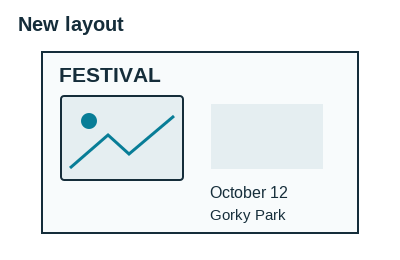
Write 2–4 sentences. This answer is for reflection or feedback from a teacher or peer; it is not scored automatically.
One possible answer: For example: the name of the event is at the top, and the date and address are separated from it by other blocks. I will put these three lines side by side so that the viewer immediately understands when and where the event will take place.
You have practiced giving substantive feedback: naming the observation, change, and effect to the viewer.
One possible answer: For example: the name of the event is at the top, and the date and address are separated from it by other blocks. I will put these three lines side by side so that the viewer immediately understands when and where the event will take place.
The result is saved only on this device. To submit it to your teacher, download or copy the answers and submit them through your usual submission channel.
How to assess the written response
0 points - there is no answer or it is not relevant to the task; 1 point - there is an observation or suggestion without a clear explanation; 2 points - the answer links the element or principle to the perception and justifies the decision. This response requires human review.
How work is checked
What are points awarded for?
For practice you can get up to 25 points: up to 10 for six compositions and their reworking, up to 10 for analyzing two designs and up to 5 for working with feedback. Points help you see what has already worked and what needs to be improved. Tests between assignments are not included in this amount.
For each criterion, select the level that best describes the work presented. If the material is not presented according to the criterion, 0 points are given for it. The evaluation takes into account the visible solutions and explanations of the author.
Compositions and revision
Up to 10 pointsWe look at the six original and six revised compositions: whether the restrictions of the first task are met, whether the forms convey the given words, and whether changes after feedback are explained.
- Elementary0–6
- Some compositions or new versions are missing; individual solutions violate constraints. The connection between the arrangement of squares and the word and the explanation for the changes are still unclear.
- Developing7–8
- All six words are presented in original and new versions. Most decisions are readable and changes have a purpose, but some explanations are loosely related to what is visible.
- Confident9–10
- Six original works respect the restrictions; six new versions develop each word expressively. The author shows what comments he took into account and explains the changes through specific Gestalt principles.
Analysis and improvement of design
Up to 10 pointsLet's look at two found examples, their diagrams and an improved diagram of an unsuccessful design: are the conclusions confirmed by the visible features of the layouts?
- Elementary0–6
- Examples or diagrams are not presented in full. The pass/fail assessment relies almost nothing on visible signs; the proposed improvement is missing or does not solve the named problem.
- Developing7–8
- There are both examples and diagrams, and the appropriate principles are named. The improved design partially solves the problem, but the connection between observation, change and viewer perception is not fully explained.
- Confident9–10
- Two examples and diagrams allow you to compare the compositions. The author shows exactly where the Gestalt principles operate, eliminates the specific problem in the new design, and explains how the viewer now reads the message.
Working with feedback
Up to 5 pointsWe watch how the author discusses work with a teacher, another person or an AI tool: what the interlocutor noticed, whether it coincided with the plan, and what decisions the author changed.
- Elementary0–2
- Almost no feedback or conclusions are saved. The author briefly names the impression, but does not show how it is related to the composition and what can be changed.
- Developing3
- Comments are recorded; the author compares them with his plan and proposes individual changes, but explains them in general terms for now.
- Confident4–5
- The author records specific observations, compares them with his plan and explains what changes he made or reasonably rejected. Conclusions are related to Gestalt principles and visible results.
The rubric is adapted from the AIGA scale for this practice: group discussion can be replaced by feedback from the teacher, another person or an AI tool. It can be used for self-testing; this website does not provide automated assessment of uploaded work.
The exercises are adapted from the AIGA material “2D Design Basics: Gestalt—Shape, Balance, Rhythm, Unity.”