Design process: practical tasks
From the question “why?” — to research, ideas and corporate identity.
Don't start with a ready-made answer. Understand the situation, study the audience, find different ideas and show how the chosen solution works in life.
How to complete tasks
Seven tasks await you. To research, find a logo and the final corporate identity, choose one fictitious company. Exercises with unusual questions and mind maps can be performed on individual topics: they train ways of thinking.
- Understand the problem without accepting the proposed format as a ready-made solution.
- Come up with a company, research two possible audiences.
- Practice searching for ideas using questions and associations.
- For your company, make 50 logo sketches → 5 drafts → 3 refined versions.
- Choose one logo, develop a visual system, and apply it across four media.
- Show the entire path and explain what you changed after checking.
Paper, pencil, marker, magazines, glue and sketchbook will do. Digital instruments are acceptable. Keep a journal: question, source, observation, conclusion, and next action. Note where is fact and where is your hypothesis. Save intermediate versions.
Task 1. Find the real problem
Study situation: A music group reports falling sales and asks for a promotional poster. You are the design team. You need to figure out what's worth checking before you propose a design. There is no need to create the poster itself. The original was named Nirvana; Here we use a fictional group to separate the scenario from the history of the real group.
- Write down separately the observed situation (“sales have decreased”), the goal and the solution proposed by the client (“poster”).
- List at least five possible reasons. For example: the product is more difficult to buy, the audience has changed, the offer is poorly known. For now these are hypotheses.
- Suggest at least five actions related to these reasons. Indicate what cause each checks or corrects.
- For each hypothesis, write down what information is needed to test it and where to get it. This is a clarification of our course.
- Prepare a short verbal explanation: Why aren't you making a poster yet? Work independently or in a group of 3-4 people.
Task 2. Study the audience
Think of a company: what it offers, where it operates, and what problems it helps solve. You can choose a longboard production facility, a workshop, a cafe, or another understandable product. Describe two possible audiences and create two different mood boards. Here the moodboard shows people and their surroundings, rather than a ready-made corporate identity.
- Describe the company, product and terms of use.
- Research the industry, competitors, customers and their habits. Use at least three different approaches for each audience: for example, researching sources, interviews, and observation. Save links and entries; Don’t make up interviews that weren’t conducted.
- Answer: who are these people, what do they need, where and when do they use the product, how do they choose and buy it? Separate information from speculation.
- Write two portraits of the audience. Provide evidence of relevant details; Indicate fictitious details of the educational story separately.
- Put together two mood boards of images, text, and samples. The original combines found, painted and printed materials; digital collage - course adaptation. Label why the essential elements are included.
- Write a one-page summary story that connects the company, audiences, and mood boards. Imagine the result.
Task 3. Ten unusual questions
Pick one subject and ask ten “Wouldn’t it be funny if...” questions. Each question should propose a new transformation of the subject. For example, the apple became square, got shark teeth, or turned into a folding tool.
- Quickly draw the original subject.
- Write down ten different continuations of the question.
- Make ten corresponding mini-drawings. A neat illustration is not required: a clear idea is important.
- Show the series and explain which questions helped move you beyond the first obvious option.
Task 4. Association map
Connect an object and an emotion through a network of associations. You can randomly draw words from two sets. Don't make one straight chain: create several branches and intersections.
- Write down the subject on one edge of a large piece of paper, the emotion on the other.
- Add associations from both words by connecting related concepts with lines. Explore multiple paths.
- Choose an interesting route or group of words and highlight them on the map.
- Write a coherent 2-3 page story using the chosen connections.
- Present the story and explain how the map helped you come up with it.
Task 5. Fifty logo ideas
Return to the company from assignment 2. Based on your research, make 50 different search logo sketches. Clarifying the “logo” format links this exercise to the following: this is the sequence that AIGA shows.
- Formulate the purpose of the logo: who it represents, who it is intended for, and where it will be used.
- Make a list of the meanings and characteristics of the company that are useful for searching.
- Make 50 small, numbered sketches. Change the idea, shape, composition and connection of the sign with the name.
- Don't choose your final too early. First, put the options side by side and mark promising directions.
Task 6. Develop a logo
From 50 sketches, choose five promising ideas. Develop them and prepare three different final versions for one company. Explain the choice through the task and conditions of use.
- Select five ideas and briefly explain the potential of each.
- Create five more detailed drafts; make additional versions if necessary.
- Compare them and choose three directions to refine.
- Test understanding and discernibility: Show options to other people, preferably members of the audience, without suggesting the expected answer.
- Record your comments and make any necessary changes.
- Show each of the three final versions in two sizes on the largest side: 127 mm and 12.7 mm. All options should work in black and white; gray is allowed.
Task 7. Apply a corporate identity
Choose from three logos and create a cohesive visual system for your company. In the original, the task is called “Company Brand”; here we are developing its visual part. Reputation and service experience are broader than a set of layouts.
- Go back to your research and explain which audience you are choosing and why.
- Determine the logo, slogan, corporate colours and the nature of the photographs. Finding consistent typography is course refinement.
- Explore several combinations and write down the reasons for your final choice.
- Apply the system on four media: business card, billboard, clothing and one other medium of your choice. You can make paper sketches or digital mockups.
- Check the scale: is the sign readable from a distance, does the sign on clothing work, is the business card information clear?
- Put together a presentation: challenge, audience, exploration, idea development, system, and four applications. Explain at least one change following feedback.
Assessment and delivery
The source materials include criteria for logos, branding, and presentation. Exercises 1-5 do not have individual points assigned: here they receive feedback on the specified self-assessment criteria and indicate the progress of the project. Do not re-combine them with the final rubric.
- Three logo solutions - up to 10. Clarity, memorability, accuracy, relevance to the task.
- The company's visual system is up to 10. Consistency of components and rationale for decisions.
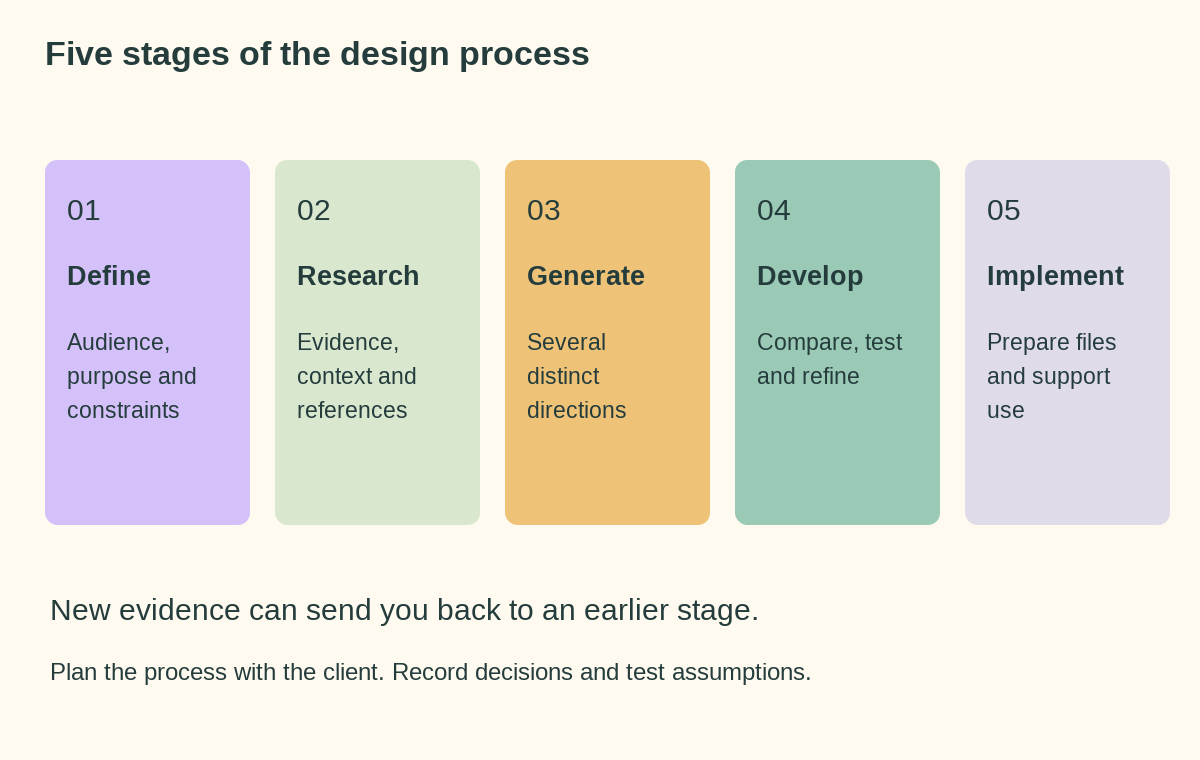
- Presentation and discussion — up to 10 points. Understanding the five stages, reasoning and meaningful suggestions for improvement.
30 - the sum of three lines of 10 points each; the total maximum is not printed in the original. In the original table, the section numbers and list of tasks do not match the lessons. Here the criteria are related to the actual content of tasks 3E and 3F.
- 0–6 - Beginner: The message or connections are unclear, there is little explanation, the work is incomplete, or the understanding of the process is weak.
- 7–8 - developing: the idea is mostly clear, the system is partially consistent, there are explanations, but lacks precision and depth.
- 9–10 - confident: the solution is clear and convincing, the system is holistic, the choice is explained through the task and research; the student understands all stages and suggests meaningful improvements.
For presentation, the ability to name the five stages and show them in your own work is taken into account. When studying independently, an oral presentation can be replaced by an audio or video recording with a written analysis. This is an adaptation of the course; confidence in presenting and recording quality are not the purpose of the assessment in themselves.
Foundation: AIGA Unit 3B "Define the Problem", 3C "Learn", 3D "Generate Ideas", 3E "Design Development", 3F "Implementation" and "Unit 3D and 3E Rubrics". AIGA Minnesota Innovate Project. The self-test criteria, the format of independent work and clarification of requirements are adapted for the “Open Grammar” course.
What changed from the request to the result?
Name one assumption that had to be revised; one discovery from the study; one idea that you gave up; one improvement after inspection. Explain how the final solution meets the problem and what you would check after applying it.