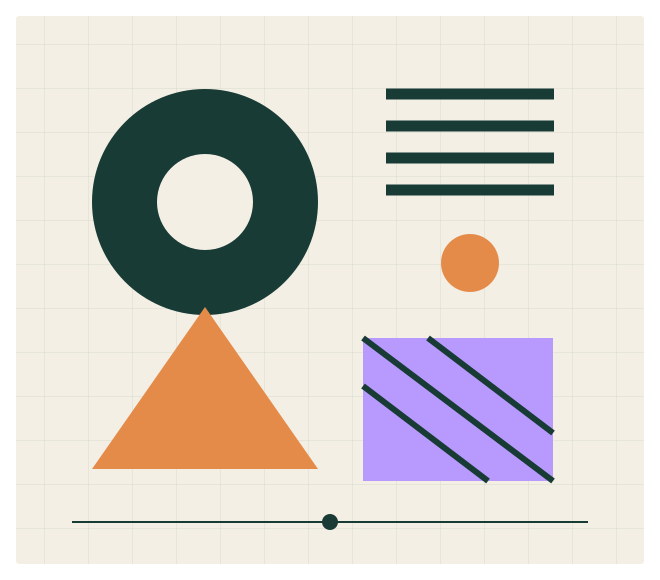
Introduction to graphic design
Learn how visual ideas become clear messages, and build the skills to create your own.
Graphic design helps convey messages through image, text, colour, and composition. We see it on posters and packaging, in navigation and digital interfaces. The designer's job is to figure out who needs to communicate what, and then find a clear visual form.
Course content
- 00
Introduction to graphic design
Learn to see design as a visual message, with an audience and a purpose.
- 01
A designer’s working method
Move from thumbnail sketches to refined ideas and a finished composition.
- 02
The elements of design
Explore point, line, plane, shape and texture — the building blocks of an image.
- 03
Gestalt and visual perception
Discover how proximity, similarity and figure–ground relationships shape what we see.
- 04
Colour theory
Understand colour models, relationships and the effect of context on a palette.
- 05
Type and typography
Choose typefaces, build hierarchy and make text comfortable to read.
- 06
The design process
Work through research, idea generation, development, presentation and review.
- 07
Grids in graphic design
Bring structure to a page with margins, columns, modules and alignment.
- 08
Writing a design brief
Ask useful questions and turn a vague request into a clear design problem.
- 09
What makes a good layout?
Connect content, images, type and spacing in a coherent composition.
- 10
The principles of graphic design
Put balance, contrast, emphasis, hierarchy, unity and rhythm to work.
Who will benefit from the course?
The training course was created to help those interested in learning the basics of graphic design. It focuses on providing basic knowledge to entrepreneurs, marketers, and aspiring designers. The curriculum will teach you how to use design thinking in graphic design, solve problems, and differentiate good design from mediocre design.
Benefits of the course
Inclusiveness is an approach that tries to take into account the different capabilities and needs of people. Course accessibility concerns language, navigation, material format, and required tools.
You can start learning the basics without paid programs or special equipment: for the first exercises, just paper and a pencil are enough. We explain new concepts as we read. The availability of training also depends on other conditions, so we will improve the course based on reader feedback.
Professional terminology
Important terms are underlined: hover over or click on a word to see a short explanation. Then try to apply the concept to your own work.
Digital tools are important but not required to learn the fundamentals of traditional graphic design and visual communication. Computers and software are important devices needed to achieve professional success, but they are just tools. If design only served to organize text and images on a page, machines would have already replaced graphic designers. However, in addition to facilitating simple communication, graphic designers also strive to stimulate intellectual and emotional responses. Thus, the role of graphic design is not only to communicate and explain, but also to be a catalyst that pushes the viewer to a new way of looking, perceiving or thinking about the world.
About the online course
It is better to go through the lessons in order: read the explanation, look at the examples, complete the exercise and compare the result with the purpose of the task. For the first steps, paper and pencil are enough. Save multiple options and write down why you chose one - it's easier to see how your decision evolves.
Theory and practice
The course combines design theory with practical exercises. Read, make several alternatives, compare them against the brief, then revise your work.
Ideas, A refined sketch develops a promising idea in more detail. It comes after quick thumbnail sketches and before finished artwork., analysis
To get the most out of the course, the student must learn to generate ideas, create the necessary amount of sketches, analyze and be receptive to criticism.
Design thinking is a way to solve problems by studying people's needs, searching for options, creating prototypes, and testing solutions.
In addition to visual communication, the main goal of this curriculum is to teach design thinking. With the help of design thinking, problems are solved in the fields of transport, medicine, education and environmental protection.
Additional education
Use the course for independent study or alongside a class. No previous art education is required.
Why do you need practice?
This course consists of theory, which is collected in the shortest possible format, practice and professional vocabulary. It is difficult for someone who has decided to learn design to start developing projects without fundamental concepts, so practical tasks play a significant role in learning.
In this course I have tried to provide examples of personal work where appropriate. And also a central part of the course is the lesson about the design process, which explains the basic method of creating projects in graphic design.
Observation: orange shape, leaves and first sketches
From orange to poster: how to make a decision
Let's imagine a problem: we need a poster for a regional citrus festival. A passerby must understand in a few seconds what the event is dedicated to, and then find the date and place. This is a tutorial example and not a description of a real order.
- Observation. The first sketches show the round shape of the fruit, the segment and the leaves. These signs help you recognize an orange even without a photograph.
- Options. Compositions are compared on two questions: whether the theme is recognizable and whether there is free space for the title, date and address. An option with a beautiful form, but without space for information, does not solve the problem entirely.
- Choice. In the visual direction shown, the large orange form immediately attracts attention, and the dark leaves create contrast. For now, this is only an image of the poster: it does not yet contain information about the event.
- Test. In the tutorial layout below, a title, date, and location have been added to the image. First check it at a reduced size: do the topic and main event read? Then show it to a person who doesn't know about the holiday. If they cannot find the details quickly, change the text hierarchy and test again.
Day12 May · noon
City Garden
What to take from this example: a successful sketch becomes a design for a specific task after the message is understood by the recipient. Compare options based on purpose, not just impression.
In the exercises for this course, designers will seek solutions to problems by transforming and creating from the familiar world Abstraction is the transmission of an idea through form, colour and rhythm without a literal representation of the subject.. You should take on a new challenge and start coming up with more ideas to overcome the habit of settling for the first design.
Often, novice designers stop at the first design option and do not overcome the barrier that prevents them from generating additional ideas and choosing the best option from them.
To do this faster, designers must be able to work with their hands and heads, come up with many ideas and learn to choose the best from them. It is also important to properly evaluate your sketches and turn them into rough drafts. The concept is the main idea of the project and the logic that connects its visual solutions., which are further discussed with the customer and become working versions of the future design.
What is graphic design?
Graphic design is the language of designing ideas with visual and textual content. Physical or digital, it consists of images, words or graphics. You can interact with the design in one moment or over an extended period of time.
In simple terms, graphic design is a visual message delivered to the recipient, i.e. The target audience is the people for whom the message or product is being created and whose needs are taken into account during the design..
Size doesn't matter in design. It can begin with the size of a postage stamp and end with the scale of a national postal sign system in Corporate style is a coordinated system of visual elements of a brand: logo, colours, fonts and rules for their use.. Be a one-off, limited edition book, exhibition design and intended for a small number of people, or something created for a multinational audience of millions who will download it billions of times. Design can inform, teach, persuade and help people navigate.
Andrey Logvin. Poster "Life is good"
Andrey Logvin’s poster “Life is Good” is an ideal example of visual communication. Using letters, colour, and simple design elements, the author sends a visual message. The contrasting materials and lettering carry part of the message, but the words still matter: the Russian title translates as ‘Life is Good’. Visual communication can cross language boundaries without being independent of language or culture.
Graphic design is a visual language used to create a message. It is used to tell someone what they want to hear about. Design serves to make things more understandable or even save lives, and to simplify our routine.
Maybe you have noticed how difficult it is to find, discover, or learn something for the first time. Design helps you understand and assimilate information faster. Graphic design is inextricably linked to all aspects of society: it educates, warns, agitates and prohibits. It is a sign that forces the driver to stop, a label with information about the presence of cholesterol in a product, the credits of a film that graphically display its theme and content.
The very idea of design suggests that it serves something or someone, but in the context of 21st century society this seems anachronistic. During the October Revolution of 1917 and during the Civil War, Mayakovsky's posters served simple purposes - propaganda, camouflage and information, responding to government requests. Today, with the help of visual language, Greenpeace is saving the world, and designers are saving someone’s life.
English reading keys for the original examples
Andrey Logvin: Life is Good
The two Russian words translate as “Life is Good”. The meaning depends on the wording, the contrasting materials and the cultural context; the poster is not language-independent. The original lettering is preserved as part of the work.
Historical Cyrillic book design
The book specimens retain their original Cyrillic lettering. The English captions identify the designer and publication. In the Moscow volume, the main words mean “Moscow” and “Architectural monuments”; Ragtime is the title of Yuri Rost’s book; the Agatha Christie dust jacket lists “The Mousetrap” and “Witness for the Prosecution”. Compare hierarchy, page structure and the treatment of lettering rather than attempting to read the body text.
How to become a designer?
When trying to figure out how to become a designer, it can be helpful to think about the qualities and interests that professionals share and see if they match yours. Access to design education varies, and many beginners have little opportunity to learn what professional practice involves. Most students attend design school and are disappointed when either the learning or the practice (or both) does not meet expectations.
People enter design through many routes: degree courses, apprenticeships, independent study and careers in other disciplines. A portfolio should show how you investigate a problem, develop alternatives and test the result.
Who can be a designer?
Above all, designers are keen observers and lovers of useful and beautiful objects, communications, messages and experiences. They pay attention to their activities throughout the day, with heightened awareness of the visual and textual world around them. They make connections and ask questions about how objects and messages around them work, what they look like, how they were made, and what they mean.
Designers are versatile people
Finally, people often become designers because they believe that having an interest is not enough. An interest in language can point the way to creating new words for life. Interest in order and structure lead to an engineering career. Direct your interest in creating meaningful things to the study of art. And interest in people - in the study of sociology, psychology, economics or business. The combination of the above interests helps you find your place in the field of design. Some of them overlap. For example, architecture and fashion design, industrial design and interior design, but graphic and communication design are the only fields that consistently look at the ways people communicate with each other.
What does a designer need to know?
Technology, social context and ways of working have changed. To remain relevant in their practice, designers must continually study and develop formal concepts, methods, and theories. Although professionals often focus on a particular specialty, none of them work in a vacuum. It is important to know and understand the history of design and art theory and how it intersects with the wider fields of politics, economics and technological progress.
Design education develops alongside changes in industry, culture and technology. Whatever route you take into the profession, connect practical skills with research, history and critical reflection. Tools and job requirements change; the habit of learning helps you adapt.
Design theory
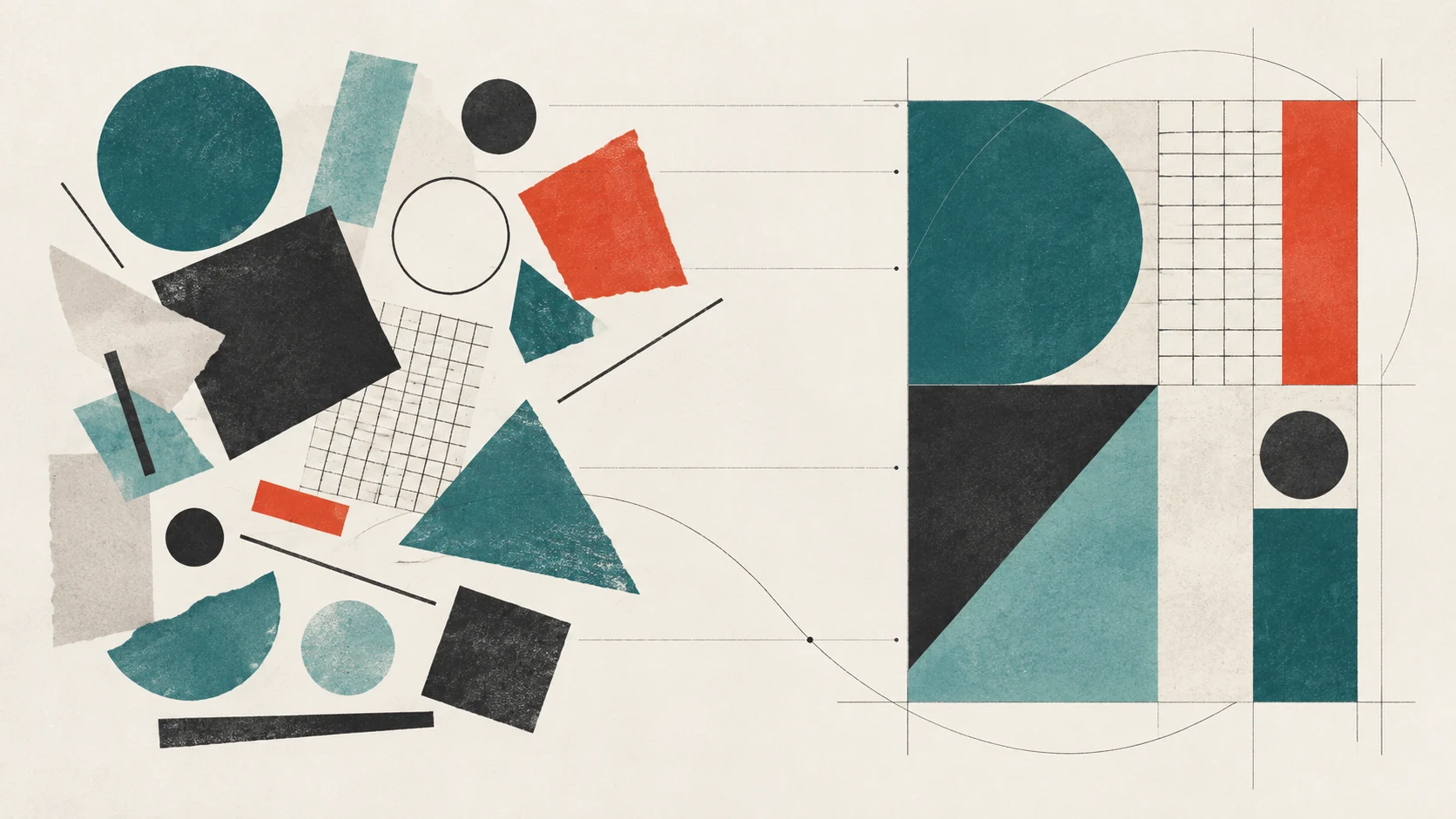
Theory refers to any system of ideas that helps explain or reflect on why we do what we do. Of course, designers regularly read and use theory from other fields: art, architecture, economics, anthropology, sociology. However, reading and writing design theory is how designers talk to each other to discover commonalities beyond everyday questions about business or technology. Also, theory changes and builds along with culture and technology, as new relationships, tools, and modes of consumption create new questions.
Theory is often presented as the opposite of practice, but in reality it comes from practice as designers face the same questions over and over again in seemingly unrelated situations. How do technologies or tools influence aesthetics? Should designers consider themselves authors? Do designers have ethical responsibilities? Are there universal truths in design or is everything relative? What is the role of a designer if anyone can now create and borrow work?
Technologies in design
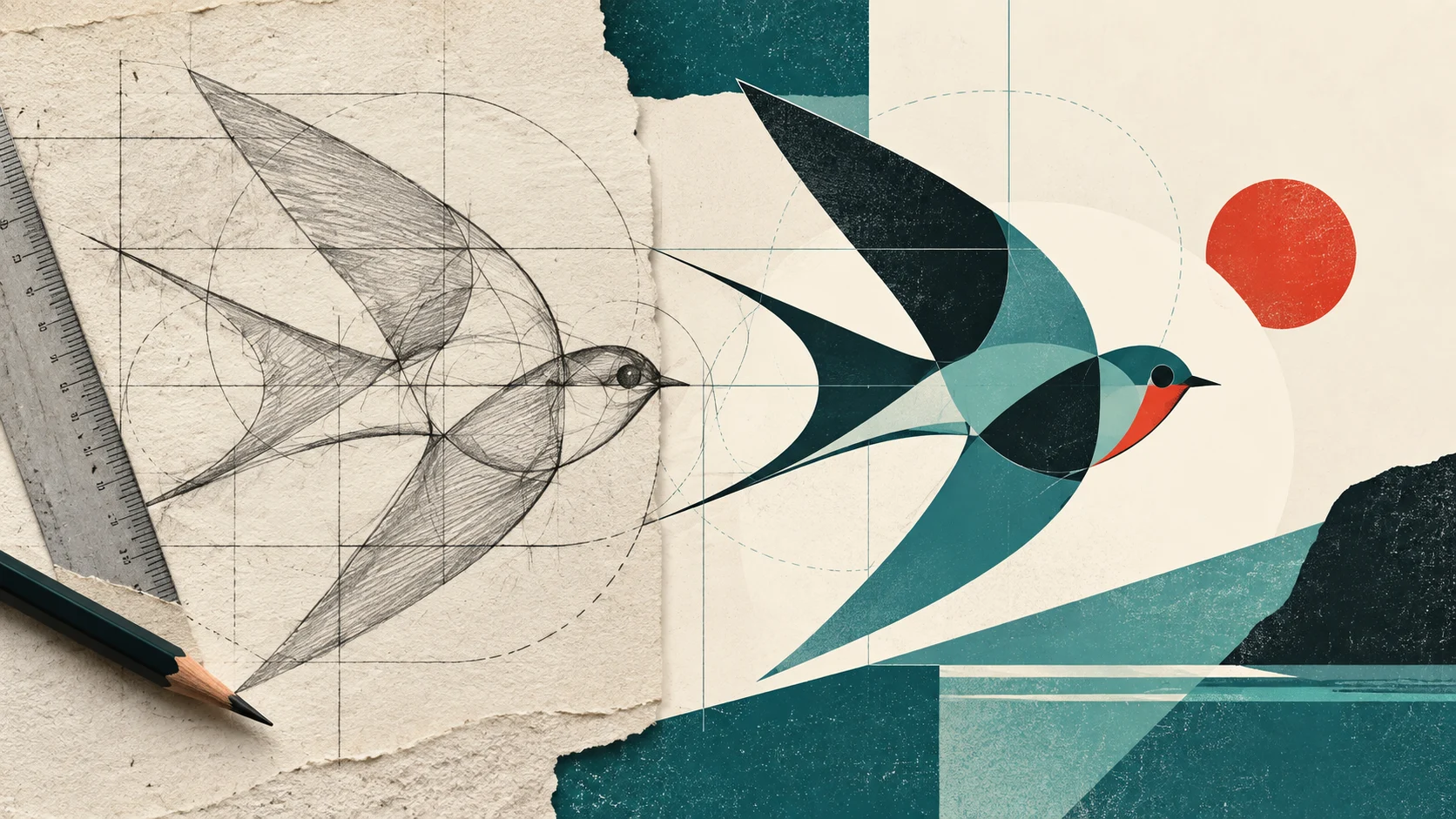
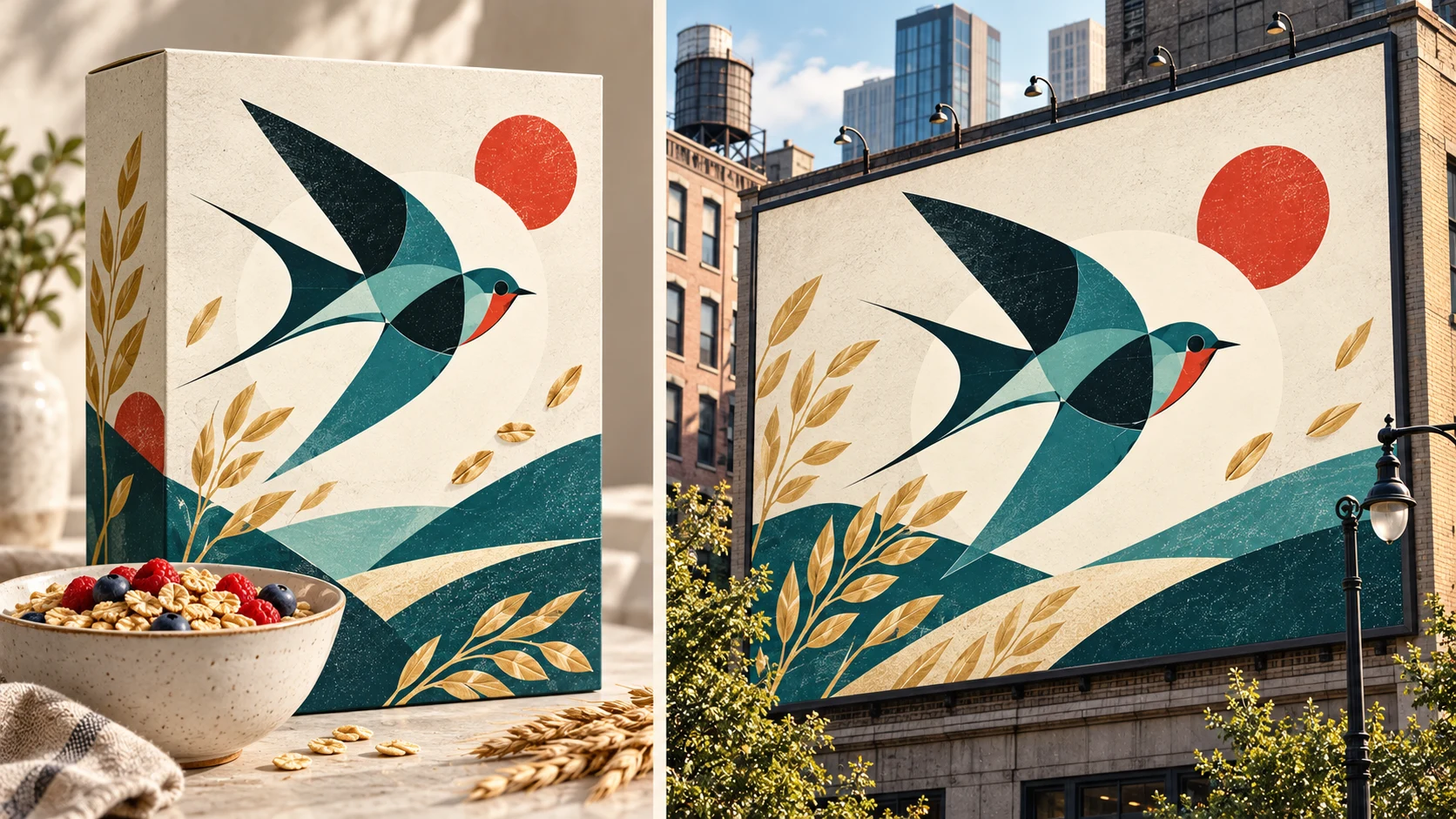
Technology is changing the way a designer works, from sketching on paper to digital composition and now to images created using artificial intelligence. But the instrument does not decide what idea to convey and how the viewer will understand it. The designer is responsible for this.
Today, a designer works with graphics editors, collaboration tools, and systems that generate text and images. Artificial intelligence can help you quickly explore options, put together a rough look, or try out different compositions. The result has to be checked and refined: the image may contain errors, may not correspond to the task, or repeat someone else’s visual solutions.
A separate direction is generative art. The artist or designer sets the rules, parameters or text description, and the system creates many options. Here, not only the result is important, but also the intention: why these particular rules were chosen, what options were left, and what the work tells the viewer.
In the course, we will focus on the principles that maintain meaning across changing programs: idea, composition, typography, and visual communication. Digital and generative tools will help find solutions, but the final choice, quality control and responsibility for the work remain with the individual.
What a designer actually does
Original Open Grammar lesson · English synthetic narration · Read the full transcript
A community-garden poster provides a practical example: define the audience and message, explore several directions, build a reading order and test the result.
Watch actively
Pause after each stage and write one decision you would make. At the end, sketch a different poster for the same event. Explain how your choices help a passer-by find the date, time and location.
Additional materials
A selection for those who want to gain a deeper understanding of the introduction topics. Start with the question that interests you: you can read the materials in any order. The learning resources below are in English.
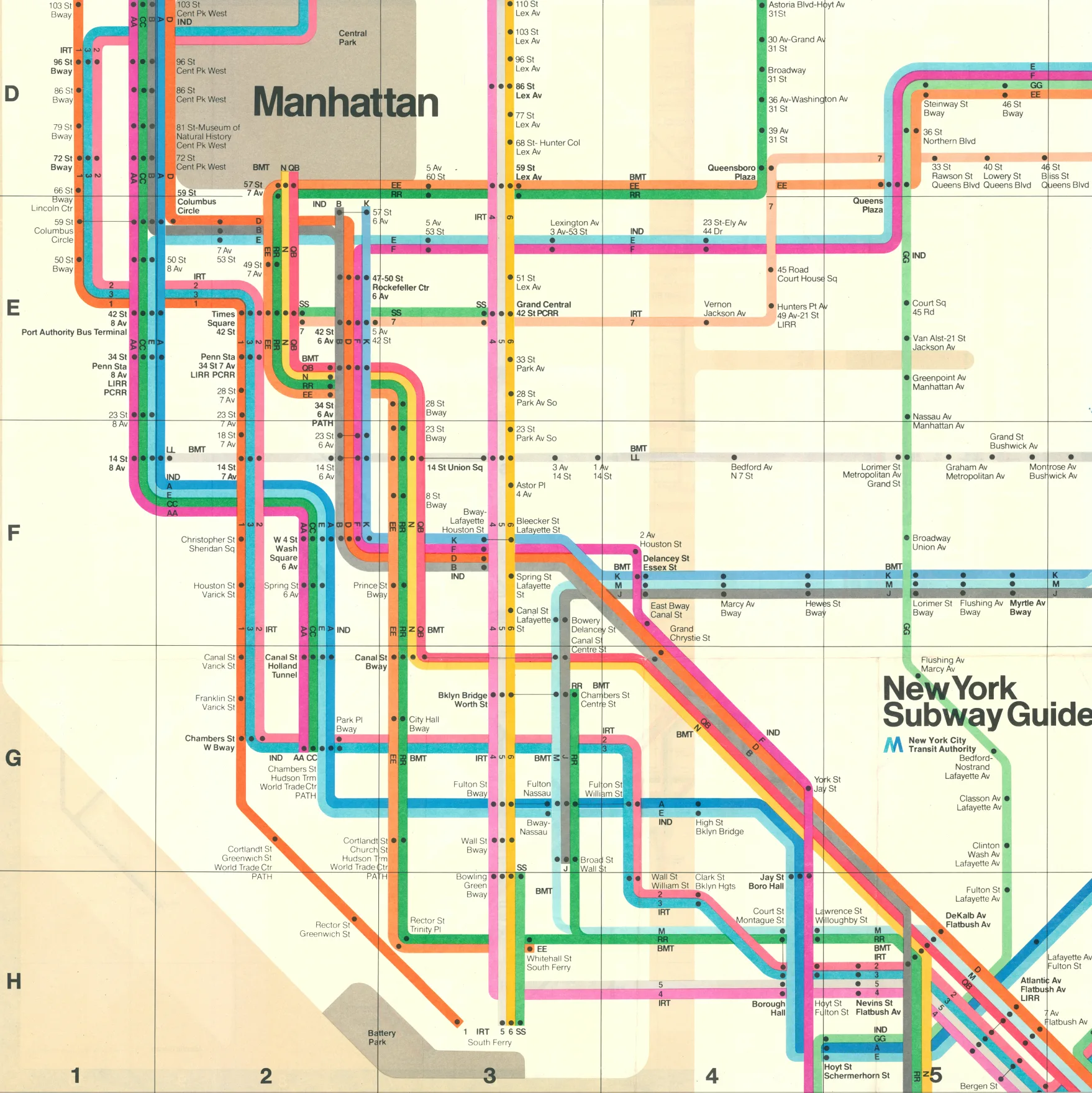
Massimo Vignelli
The New York City subway map shows how complex information can be turned into a clear visual system. Explore it with The Vignelli Canon, a short book about design principles.
Image: Vignelli Center for Design Studies, RIT.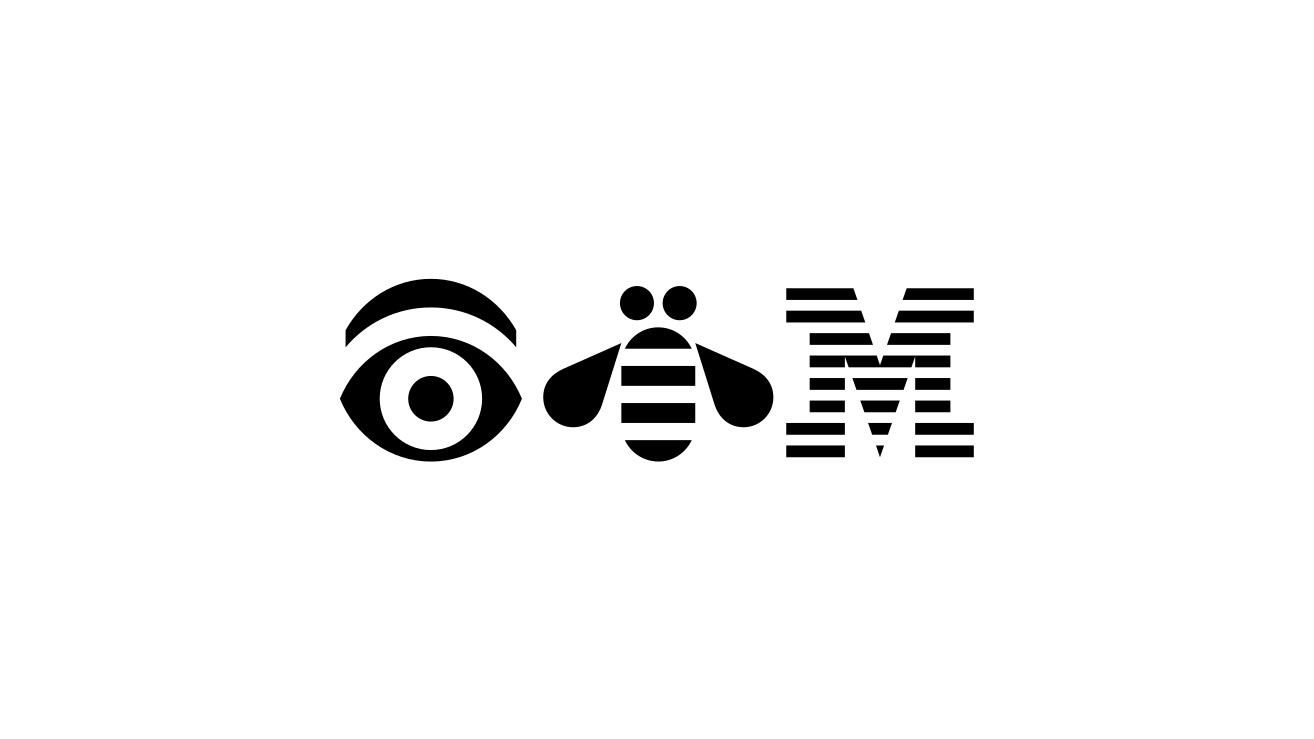
Paul Rand
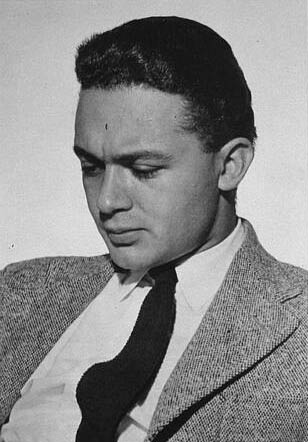
Photographer unknown.
Source: Library of Congress, Prints and Photographs Division, cph.3f05881. File and rights information on Wikimedia Commons. Public domain in the United States.
The Eye-Bee-M poster shows how an image and a letter work together to create a memorable message. Rand also wrote a lot about how a designer thinks and works with a client.
Eye-Bee-M poster: IBM Design Language.Continue learning in English
- Google Fonts Knowledge
Type anatomy, choosing type, spacing and practical typography.
- IBM Design Language: 2x Grid
A published grid system connecting type, images and different media.
- Design Council: the Double Diamond
A framework for understanding a problem, exploring alternatives and testing solutions.
- W3C: images tutorial
Choosing text alternatives for informative, functional and decorative images.
- MDN: responsive design
How flexible layouts and breakpoints respond to available space.
Next - the first lesson and test task
In Chapter 1, you will learn a practical method for developing ideas: make thumbnail sketches, compare alternatives, refine your chosen directions and complete a finished composition. Four exercises will help you practise the method.
Go to lesson 1 →Your progress is saved in this browser.
Back to all chapters ↗