 Chapter 8
Writing a design brief
We create a written agreement between the customer and the designer, in which we will set out the main parameters of the future graphic project.
Chapter Contents
- 01
Introduction
How to read this chapter
- 02
Relevance
Expectations, deadlines and relationship with the client
- 03
Purposes of creating a brief
Purpose, audience and message
- 04
What is a brief?
Formats, sizes and five templates
- 05
Brief Basics
Introduction, problems and technical specifications
- 06
4 steps to a successful design brief
From interview to approval
- 07
Main sections of the brief
Seven examples of the Brenda studio
- 08
How to improve a creative brief?
Six tips for working with a team
- 09
How to quickly create a creative brief
Goodbrief practice-brief generator
- 10
Summary
Main conclusions of the chapter
- 11
Directory
14 Graphic Designer Terms
- 12
Review questions
Five questions before starting a project
Introduction
In the Brief chapter, we will understand the purposes of creation and learn the main mistakes when drawing up a document. There is little structured information on the topic of the brief, but the chapter contains the minimum necessary for a general understanding of the topic. At the end of the chapter I have included a reference guide to key terms.
Relevance
This chapter explains how to agree on a task, document expectations and maintain a productive client relationship. We will talk about an assistant hidden from prying eyes, without whom it is difficult to imagine the modern relationship between the contractor and the customer.
We strive to do the work quickly, efficiently and on time. To do it right, you need to understand the goals and objectives of the project. When starting work, the designer strives to avoid confusion and make the project the shortest and most correct way.
Purposes of creating a brief
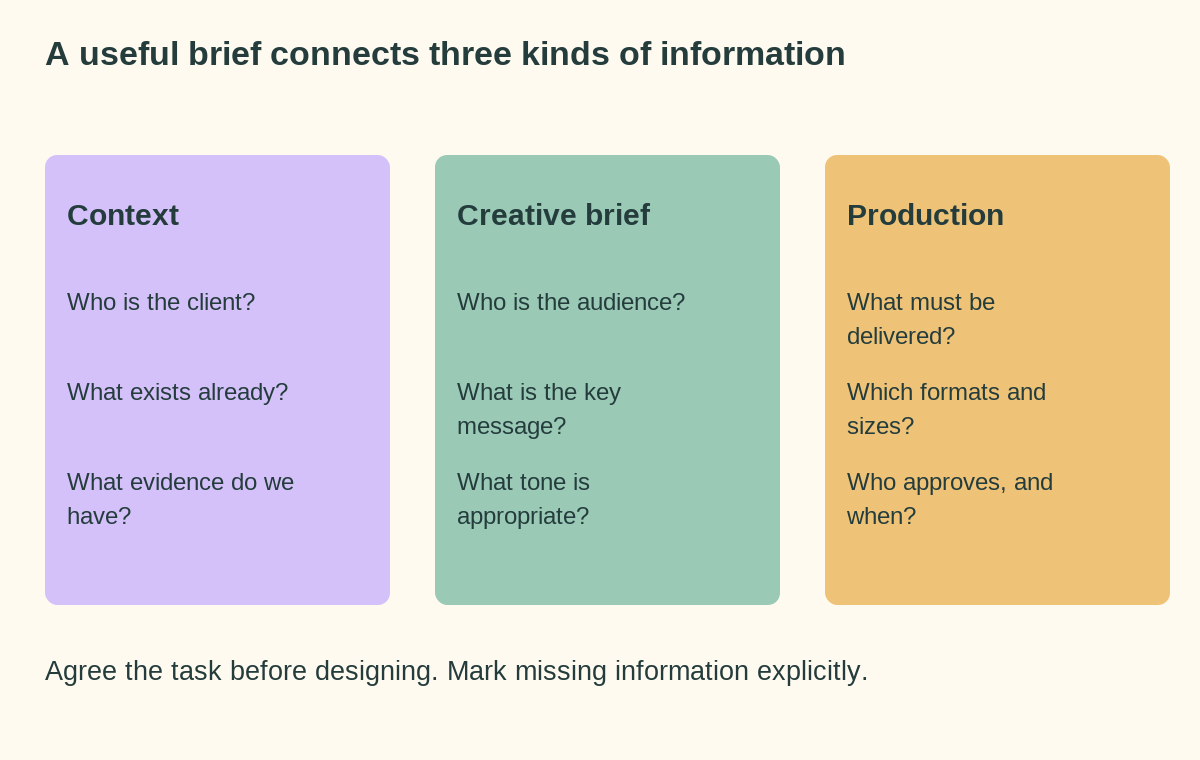
Record three things: what result the customer expects, to whom the message is addressed, and what exactly the viewer should understand. For example, the task might be to explain a new service, make navigation clearer, or introduce a product range.
Then agree on the criteria by which you will evaluate the solution: readability, clarity of the main message, relevance to the audience and medium. Specific goals help the team compare options, but do not guarantee a commercial outcome.
What is a brief?
A brief is a detailed description of the assignment drawn up by the client and/or designer. It describes the goals of the project, The people for whom the product and message are intended. Their features help you choose the content and method of presentation., deadlines and general tasks. It also details constraints such as budget and timelines, and often anticipates future considerations.
Formal and/or informal
There are official and informal versions of the brief. An official document is sent by email to receive a standard commercial offer and monitor the market with prices.
The informal version is born in a telephone conversation when a client or manager calls the designer and/or studio manager to describe the goals and objectives of the future project. At this point, the designer or manager needs to be prepared and take notes, which in the future will become a formal brief.
Open and/or closed
In a closed type of brief, the designer is required to adhere to a strictly outlined concept, which determines the style and overall visual solution. As a rule, specialized designers prefer to receive the second type of brief: motion designers, logo designers, illustrators or 3D designers.
Knowing the difference in briefs helps you understand how much it costs and whether you want to do it. Clients may not know the difference between an open or closed brief. In this case, a few direct questions will help you.
Brief size
The brief is a very important document that requires careful study. If the contractor has superficially familiarized himself with the brief, then he cannot correctly create a technical specification, which will be an agreement between the customer and the contractor.
For complex projects we use a detailed brief, for simple ones - from one page. The detailed version of the brief consists of 3 documents: a description of the marketing situation, creative and technical specifications.
A simple brief is a one-page document. It summarizes information about the project and the client. The main advice when drawing up a brief is to answer questions in short and succinct phrases. Know that people don’t like being bored to death with a lot of text.
Conclusion
Templates and examples
I like the Berkeley option because you don’t have to invent it The brand's communication style: for example, friendly or reserved. The brief helps to agree on the nature of the message. and answer the question “What are we?”, or you can choose from the listed descriptions. It also captivates with the ability to interactively fill out a PDF document.
The brief from Gareth David is the most voluminous and complete in terms of information; it can be downloaded from the author after registration. It impresses with the completeness of the questions asked, but can scare off those who are just starting their career.
The creative brief from 99Designs, like other documents, has common sections and elements: audience, key message, means of communication, etc., but what distinguishes it is the presence of colour schemes and the choice of brand voice.
Brief from 99Design
Optional external template. Viewing and download options depend on the author’s access settings.
Brief from Berkeley
Optional external template. Viewing and download options depend on the author’s access settings.
Brief from Brenda studio
Editable DOCX · English · included with this textbook
Brief by Gareth David
Optional external template. Viewing and download options depend on the author’s access settings.
Brief from DesignModo
Optional external template. Viewing and download options depend on the author’s access settings.
Brief Basics
Part No. 1. Getting to know the project
Go to the sales department, meet the executives and managers. Talk about customers, find out what is happening and what influences sales, which of the services is the most popular, which of the goods is the locomotive of sales. Ask in more detail about the purchase scenario from an online store.
Request marketing and promotional materials. Review the current state of the website, print materials, mobile app and other brand designs. In the first stage, the designer establishes relationships with people and the project in order to build long-term cooperation.
Part No. 2. Project issues
During the presentation of the project, the conversation smoothly turns to problems. Try to write down all the questions and wishes voiced by the sales department, business owners and ordinary managers who work with design. These may be problems with the reproduction of colour schemes, arrangement of elements, recognition, and readability. The problem could be with the logo, the use of colour, or Working with font and text layout to convey a message and make it readable..
At the “problematics of the project” stage, the designer asks the questions: “What design is relevant and what is not? Which of the outdated fonts, colour schemes, and logo designs need to be updated and which should be left behind?” After discussion, it is necessary to record the tasks, as they determine the scope of work on the project. Make a list of tasks and agree on it at a meeting with clients to synchronize and draw up detailed technical specifications.
Part No. 3. Terms of reference
Choose communication channels from evidence about the audience’s activities. Find out where people encounter the product, what information they need and what influences their decision. Age, gender or occupation alone does not establish which channel will work.
The format and channels of communication are changing rapidly, yesterday television advertising and the Internet worked well, today - Authors whose audience takes their opinions into account. When choosing a channel, compliance with the audience and the task of the project is important. with an audience of millions, tomorrow these will be microblogs that your target audience is subscribed to.
The choice of format and quality of the channel directly depends on your goals and objectives. Use the “who, what, how and with whom” formula. Who is your target audience, what is your message, how is your format, with whom are communication channels.
4 steps to a successful design brief
Ask questions
Set up meetings and conduct interviews with decision makers. Ask about the company, goals, values, audience. Query the current visual positioning.Study and process the answers
Identify key points in a way that suits you: email, conversation, interview. Create a single document.Structure your key points
Send the agreed document to each member of the working group for review. Ask for feedback and set time intervals.Finalize and agree
Get feedback from the working group, take into account the feedback and wishes of managers. Sign before design begins.
Main sections of the brief
Describe the company
Who are you? What are you doing?
Find out your goals and objectives
Describe your target audience
Find out the content and message
Creative concept
Working group
How to improve a creative brief?
Tip #1: Prepare to compromise
Creating a good brief is more difficult than repeating a recipe for a delicious pie. Correct answers do not guarantee results. A technical specification is a plan that predicts how problems will be solved. Sometimes you have to do everything wrong to get a unique design. Don’t try to include all the answers in the brief; add only the key ones that won’t confuse the contractor.
Rule #2. Investigate like a detective
Ask clarifying questions and check your assumptions with the client. Write down the answers in the brief so that the team works towards an agreed upon task.
Rule #3. Dig Deeper
Then select what the team needs to do the job: purpose, audience, message, and constraints. Separate confirmed information from assumptions and agree on controversial points with the client.
Rule #4. Identify Key Ideas
Rule #5. Inspire your team
Keith Altin's piece in D&AD about the brief that inspires the team.
Rule #6. Create Mood board of images, fonts and palettes; Helps coordinate visual direction.
How to quickly create a creative brief
The site generates short briefs for the development of a logo, corporate identity, illustration, and even a website. The list of industries includes retail, technology, entertainment, fashion and more. Use it to practise interpreting a brief and identifying questions before you start designing.
Goodbrief Interface: Choosing a Design Type and Industry
Summary
Don't be afraid to ask questions
Ask focused questions and listen carefully. Follow up on unclear answers without turning the conversation into an interrogation.Harness the power of the brief
The brief can be your friend or your enemy. Use the hidden capabilities of the brief, write down and agree on any details, even minor ones.Focus on what's important
When creating a brief, many facts will be revealed to you. Cut off the unnecessary and leave only what will allow you to achieve your goal faster.
Briefs can be formal or informal, written or oral, simple or complex. The brief always contains a specific goal that must be achieved during the design process.
The brief can be simple: “we need A character that represents a brand and helps make it recognizable.that will attract young women" or "we need a Snail that will make us cool and stylish." During the process of working on projects, a close relationship can develop between the client and the designer, resulting in briefs that are simple and may contain informal language.
The designer asks what words such as “modern”, “stylish” and “cool” mean in this project, using examples to make expectations explicit. Mutual understanding between the client and the designer helps to bring expectations and results closer together.
Sometimes designers question the content of the brief. For example, online advertising can be more effective than a billboard advertising campaign. In such cases, designers offer more optimal solutions based on their experience.
Clients have different levels of experience working with designers. If a project has no brief, help the client clarify its purpose, audience, content and constraints. Record the agreed information and identify what still needs research.
Directory
- Identity
- It is the visual representation of a brand, synonymous with the phrase “corporate identity”, brand identity and corporate identity.
- Brand
- This is the meaning of your brand, it is what people think about you, your company, product or services.
- Branding
- It is the process of giving meaning to a particular organization, company, product or service by creating and shaping a brand in the minds of consumers.
- Brief
- This is a document that details what to consider when designing or advertising something.
- Briefing
- It is the process of informing or instructing someone.
- Logo
- In design, a logo is a visual identifier for an organisation, product or service. Brand designation in the form of a word, letter, number, image. An image that is associated with the brand name. Do you remember the chicken with the golden egg, the golden arches or the apple? Every time you think about a brand, you go through a “visual gate.”
- Logo
- A logotype, or wordmark, represents a name through lettering or type. An example of a classic logo is Coca-Cola, which is in Spencer font. Mega, Vodka Absolut, Google, Heineken are examples of modern logos that can be called logos.
- Font pairs
- This is a harmonious selection of 2-3 fonts to express the author’s artistic intent. The point of selection is to find visual contrast between the title, subtitle and body text.
- Name
- This is a unique designation of a company in the form of a word, numbers or a set of letters and numbers. Perhaps the most important element of the brand. A name influences recognition, pronunciation and associations. There are special requirements for the name in terms of phonetics, sound, and pronunciation. The development of a name is expected to be unique and legally protected. You can find out more about names and naming in the article "Naming".
- Typography
- “A type of fine art, a type of circulation graphics, whose artistic language is based on the use of typographic typesetting material: font, decoration, rulers, etc.,” - Emil Ruder
- Slogan
- This is a laconic, easy-to-remember phrase that expresses the essence of the advertising message. A slogan can be registered as a trademark if it meets the requirements for the protectability of a designation. A useful slogan supports the main message and is easy for the intended audience to understand and remember.
- Images
- These are visual images. They can be icons or photographs. Icons often carry a metaphorical meaning, while photographs evoke emotions. Images can convey values and convey meaning when words are difficult to come by.
- Modular grid
- A system of columns and horizontal rows that divides the format into modules. It helps you coordinate text and image placement, spacing, and alignment. More details - in Chapter 7 “Grids in Design”.
- Brand guidelines
- This is a publication with the rules and guidelines of the brand. In a professional environment they may be called brand book, guideline or management according to corporate style. Good, reliable standards will save you time, money, stress and investment. An important part of the brand guidelines are guidelines for the use of corporate identity. The guidelines regulate the use of colours, fonts, logos and other key brand elements.
Review questions
Do you understand what the client is asking for?
Ask the client again if some of the answers are not clear to you. Try to clarify all the details in a personal meeting. Use a meeting, call or written exchange that allows both sides to clarify the task. Keep a shared written record of decisions.Does the client understand what he is asking for?
Often clients do not fully understand what they want. Clarify the basics to the client and outline the key points.Do you understand the terminology?
The designer should not be an expert in all areas, however, if the performer does not understand the client’s professional activities, then the result will be at least unsatisfactory.Found any shortcomings in the brief?
A brief can be incomplete, inconsistent or based on assumptions. Identify missing information and agree on the necessary changes before design begins.Do you know how to manage client expectations?
Do not lose control of the situation, stay in touch with the client. Try to meet his expectations; to do this, prepare questions for the meeting, a notepad, a mood board, or do your homework and study the current situation. Communicate clearly and respectfully, and explain how each decision relates to the agreed purpose.
From request to working brief
Analyze the request from the Binding workshop, prepare questions, draw up a brief and refine it after feedback. One project, four stages and two versions of the document.
Go to practical tasks →What is a layout?
English reading keys for the original examples
Novosibirsk Tool Plant
The Cyrillic company name means “Novosibirsk Tool Plant”, abbreviated NIZ. Product headings include “Hand tools”, “Socket wrenches” and “Replaceable hexagonal sockets”. Specification tables organise product codes and dimensions in millimetres. In the guidelines, the headings identify the primary symbol, logo lock-up, minimum clear space and applications.
Your progress is saved in this browser.
Back to all chapters ↗